
About This Review
This review is written by the SelfyzAI team. The SelfyzAI team has been given early beta access to Kling 4.0 as part of the model's peek-preview programme, and every Kling 4.0 claim in this review comes from what that beta actually shows, checked against the Kling 4.0 reference documentation. Where a third-party report disagrees with our beta results — we say which is which instead of picking the version that reads better. All statements about selfyz.ai were checked on October 10, 2026.
The short answer: Kling 4.0 is a generational update rather than an incremental one. Longer single takes, more control over what a shot contains, and wider format support arrive together, and the workflow gains are real — our beta results bear that out. The model is still pre-release and the specifications can change before it goes live, so nothing here is a reason to stop producing today. Kling 3.0 remains the version you can actually run, and it covers most projects well. When 4.0 goes live, SelfyzAI will add it to the model picker as soon as possible — stay tuned.
What Kling 4.0 Is (So Far)
Kling 4.0 is the next major version of Kuaishou's Kling video model family. It is currently in a peek-preview phase: Kuaishou invited partners into a joint internal beta ahead of release, and the SelfyzAI team is part of that beta. Separate settings files also surfaced in third-party trackers on September 24, 2026, which is where most of the rumour mill around the release comes from.
That distinction shapes this review. A beta shows what a build actually does; it is still not a release note, and the specifications can move before the model goes live. Every capability claim in the next section comes from our beta testing, and anything that appeared only in leaked settings files has been left out of the conclusions.
What the beta establishes is direction. Kling 4.0 targets longer continuous shots, tighter control over what each shot contains, and a wider set of output formats. The Kling versions already in the AI video generator on selfyz.ai — Kling 3.0, Kling 3.0 Turbo and Kling 2.6 — sit on the same family line, which is why a version-to-version comparison here is concrete rather than speculative.
What Changes vs Kling 3.0
The beta build shows a set of changes that land together in one release rather than arriving incrementally. Each is reported below from our beta testing, and the one place where third-party reports disagree with what the beta shows is flagged rather than smoothed over.
Native 30s Generation: single takes run up to 30 seconds
In our beta runs, Kling 4.0 delivers Native 30s Generation — native single shots of up to 30 seconds, consistent with the Kling 4.0 reference documentation. For scale, third-party trackers generally put Kling 3.0's own single-take ceiling at 15 seconds, with shorter caps in some modes. What is verifiable on our side today: the web workspace on selfyz.ai outputs clips of 2–15 seconds, and longer pieces are produced by generating several segments and joining them with extend video.
Read in workflow terms, the change matters less as a number and more as a step removed. A 30-second native take removes a joining pass from scene work, and fewer joins means fewer places for continuity to drift.
Video Generated by Kling 4.0: Tested by SelfyZ AI:
Multiple Keyframes: up to 10 per generation
The beta supports Multiple Keyframes — up to 10 keyframes in a single generation, matching the reference documentation. Keyframes are how you specify the states a shot should pass through: instead of describing a movement in text and accepting whatever the model infers, you place the arrangement you want at several points and let the model fill the intervals.
Today the same need is met differently in the workspace, where image-to-video and reference-driven routes carry most of the subject-consistency work.
Omni Reference: up to 15 reference inputs
The beta offers Omni Reference — up to 15 simultaneous reference inputs, drawn from images, video, voice or subject references in combination, as the reference documentation describes. It is a generous ceiling, and it is worth reading as a ceiling: references that disagree with one another constrain a generation rather than improving it, so the useful number is usually the smallest set that pins down what matters.
Reference-driven generation is already available in the workspace through reference to video, which conditions output on supplied images or video. For scale, Kling's official documentation puts Kling 3.0's Elements system at up to four reference images per subject, alongside video and voice references — so the move to 15 multimodal inputs is a near-quadrupling of capacity. What changes with 4.0 is capacity and breadth, not the concept.
4K, HDR and a conflict worth naming
Here our beta results and a widely quoted leak disagree, and the disagreement is more useful than a tidy answer would be. In our beta runs, Kling 4.0 outputs 4K/1080p Resolution with 10-bit HDR, plus a new 21:9 Aspect Ratio alongside the existing formats — the same combination the reference documentation lists. The leaked settings file that appeared on September 24 lists only 720p and 1080p, and several third-party sites have read that as Kling 4.0 dropping 4K.
We are not repeating that reading as a conclusion, because it does not match what the beta shows. A settings file is a configuration, not a capability statement. The honest position is that final specifications are confirmed at release — and the reference documentation carries a standing warning that specifications may change. A single confident answer on resolution is not supportable before then.
Video Generated by Kling 4.0: Tested by SelfyZ AI:
Sound Effects, Lip Sync and accents
The beta shows two-channel stereo Sound Effects, tighter Lip Sync matching, and improved handling of Multiple Languages, Accents, and Dialects — all listed in the reference documentation as well. Third-party trackers separately report support for up to three voice references. The two accounts describe different parts of the same pipeline rather than contradicting each other, so we report both and note the source of each.
The beta also shows capabilities that extend the family's editing reach: localised Video Editing on existing footage, Video Extension that extends a narrative forward and backward, and Text Generation for on-screen titles and product information. They matter for ad-matrix and serialised-narrative work, but they do not change the 3.0-versus-4.0 decision as directly as the five differences above, so we note them rather than expand on them.
Video Generated by Kling 4.0: Tested by SelfyZ AI:
Where It Fits in a Real Workflow
Capabilities only matter if they remove work. Three places where the beta changes the shape of a project rather than the length of a feature list.
Pre-visualising a shot before you spend credits
Keyframe control matters most at the start of a project, when a sequence still exists as a storyboard. Fixing several states within one generation shortens the loop between an idea and a version you can look at, and that loop — not raw output quality — is where short-form projects usually lose time.
Story-led and music-led formats
Longer native takes and wider format support line up with the formats where work already happens at sequence level rather than clip level. MyStory Agent assembles story-driven video scene by scene and outputs 15–90 second pieces in 9:16, 16:9 or 1:1. MV Agent builds a music video from an uploaded track, taking audio between 15 and 160 seconds through lyric and emotion analysis, a story outline, consistent character assets, a storyboard, per-shot generation, and a final pass aligned to the original audio.
Both are structured pipelines rather than single prompts, and both produce output longer than one clip. A 30-second native take would slot into that work without changing how either pipeline is set up, which is the practical version of what a longer clip limit buys.
Multi-language delivery from one take
Accent and regional-speech handling is a production cost that teams rarely budget for, because the usual route is a re-generation pass per market. If the beta results hold at release, one take can serve several markets without that pass. Treat that as a planning assumption to verify rather than a settled fact: betas describe this kind of capability in broad terms, and releases describe it in detail.
Real Limitations
Four points we would rather state now than have you discover after release. All four are verifiable, and the first one is the honest boundary of a beta review.
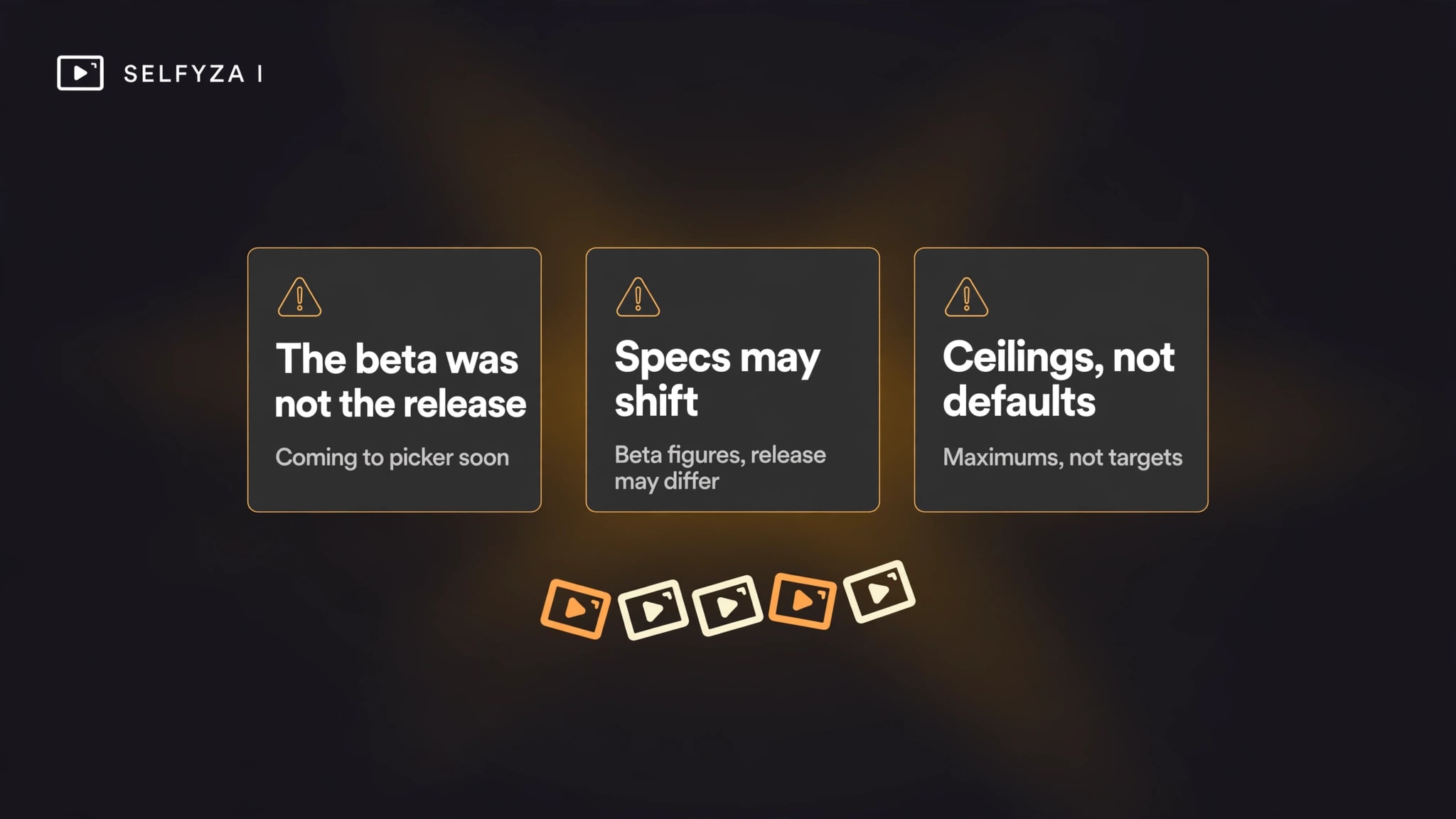
1. The beta is not the release
Kling 4.0 is in internal testing, and the SelfyzAI team is glad to hold beta access — but the model is not yet open in the public model picker. When 4.0 goes live, SelfyzAI will update its model list as soon as possible; until then, the Kling versions generating today's output are the released 3.0 family. That is also a fair benchmark for third-party claims: a site advertising public Kling 4.0 runs today is ahead of the vendor's own release schedule, and worth being sceptical about.
2. The specifications can still change
Every figure in this review comes from a pre-release beta, and the reference documentation states that specifications may change before release. The resolution conflict described earlier is a working example: a leaked settings file and actual beta output, same week, different answers. A sensible response is to plan around the shape of the change — longer takes, more frame control, wider formats — and treat the specific numbers as provisional until they are confirmed.
3. Keyframe and reference counts are ceilings, not defaults
Up to 10 keyframes and up to 15 reference inputs describe maximums. Supplying the maximum is not the same as getting a better result: ten keyframes is a lot of constraints to place on one shot, and references that pull in different directions narrow a model's options rather than widening them. Most work needs one or two well-chosen references and a small number of key states.
4. The cost side is unpublished
Kling 4.0's credit rate has not been published, and we will not estimate it. For context on how costs work in the workspace today: credits are consumed per generation, and the amount depends on the model, the duration and the resolution, with usage itemised in Credit History. No per-second credit figures for Kling 4.0 exist outside the vendor's unreleased pricing, so any number quoted for it is a guess. If you are planning a budget for a switch, the current rates for every model in the picker are on the pricing page.
How to Use Kling 4.0 on SelfyzAI
Today the version generating output in the workspace is the released Kling family; 4.0 is still in internal testing. What you can do now is run the released versions and know where 4.0 will appear once it goes live.
The Kling family is selected in the model picker inside the video workspace. Kling 3.0 and Kling 3.0 Turbo are the current options, with Kling 2.6 still available. From there, the routes are the ones already documented in the workspace: image-to-video for animating a still, text-to-video for prompt-only generation, reference-to-video for subject consistency, motion control for transferring movement from an existing clip, and extend video for continuing what you have.
Image-to-video is the most common starting point for product shots and portraits, and it is documented separately on the image to video page.
When 4.0 goes live, SelfyzAI will add it to the model picker as soon as possible, and the placement is unlikely to change: it becomes another entry in the same picker, reachable from the same routes, so a project set up today does not have to be rebuilt to accommodate it.
Who It Fits — and Who Should Wait
Kling 4.0 is in beta, so this is a planning question rather than a purchase decision. The split below is about which projects should plan around the new version and which should not wait for it.
Plan around 4.0 if your work depends on long continuous takes; you deliver the same footage across several languages and markets; or you build serialised narrative or music-led pieces where a sequence, not a clip, is the unit of work.
Stay on Kling 3.0 if you need to publish this week; your projects are short-form single-clip deliverables; or you are still working out which model in the picker suits your style. In all three cases the current version is the one producing output today, and moving to 4.0 later is a matter of selecting a different entry in the picker.
For a fuller side-by-side of the two versions, see our Kling 4.0 vs Kling 3.0 comparison.
Frequently asked questions
Is Kling 4.0 available now?
Kling 4.0 is in its peek-preview stage, with partners running internal beta tests ahead of release. The SelfyzAI team holds beta access; it is not yet open in the public model picker. When it goes live, SelfyzAI will add it to the picker as soon as possible — stay tuned.
How is Kling 4.0 different from Kling 3.0?
Four differences stand out in the beta: Native 30s Generation (single takes of up to 30 seconds) rather than joining shorter segments; Multiple Keyframes (up to 10) and Omni Reference (up to 15 reference inputs) per generation; 4K/1080p Resolution with 10-bit HDR alongside a new 21:9 Aspect Ratio; and stereo Sound Effects with tighter Lip Sync and accent handling. All four were observed in our beta testing and match the reference documentation; they remain subject to change before release.
Are the leaked Kling 4.0 specifications confirmed?
The leaked settings describe a different resolution list from what our beta outputs, which is why this review treats the leak as noise rather than signal. Capabilities that appear only in leaked material — an extended long-video mode, for instance — are left out of the conclusions, because a file the vendor has not confirmed is not a basis for telling you what a model does.
Should I wait for Kling 4.0, or use Kling 3.0 now?
Use Kling 3.0 now, unless the specific gain you need is a long single take or multi-market delivery, in which case the question is about timing rather than about whether. There is nothing to gain from pausing production, and the models available today belong to the same family.
How do credits work when I generate with a Kling model?
Credits are consumed per generation, and the amount depends on the model, the duration and the resolution. Usage is itemised in Credit History, and purchased credits land immediately and work across supported models. Because per-model rates differ, the practical cost of a specific workflow is best judged by looking at what a few runs actually consumed.
Conclusion
Kling 4.0 is a major version update rather than a point release, and based on our internal beta testing — checked against the Kling 4.0 reference documentation and the Kling versions already live on selfyz.ai — our assessment is a passing grade: the direction is right, the gains are concrete, and the open questions are the sort that get answered at release rather than reasons for doubt.
Kling 3.0 already covers what most projects need today, so nothing here argues for pausing production. When 4.0 goes live, we recommend giving it a try — SelfyzAI will have it in the model picker as soon as possible.
What 4.0 does not change is fit. If your work is short-form single-clip output, if you are not planning around long takes or multiple language versions, or if you would rather not build a workflow around specifications that can still move, then the case for switching on day one is thin — and Kling 3.0 is a reasonable place to stay.
If your work runs to long continuous takes or multi-market delivery, this is the version to plan around; the Kling versions already in the SelfyzAI picker are what you would run until it goes live.
Choosing between model families rather than Kling versions? Our Kling 4.0 vs Seedance 2.5 comparison covers the control-versus-performance trade-off — and Vidu Q4 vs Kling 4.0 puts Kling 4.0 next to the season's other major release.
Kling 4.0's specifications in this review come from the SelfyzAI team's internal beta testing and were checked against the Kling 4.0 reference documentation; specifications may still change before release. All statements about selfyz.ai — model availability, output length, credit behaviour — were verified on selfyz.ai on October 10, 2026.