
Vidu Q4 vs Kling 4.0 at a Glance
Every row below is sourced. Kling 4.0 rows rest on our beta runs plus the Kling 4.0 reference documentation; Vidu Q4 rows rest on our hands-on beta testing. Anything unconfirmed is marked as such.
| Decision dimension | Vidu Q4 (preview) | Kling 4.0 (preview) |
|---|---|---|
| Announced focus | Performance and camera craft: acting, dialogue, camera movement, lighting aesthetics | Longer takes and shot control: Multiple Keyframes, Video Editing, Video Extension |
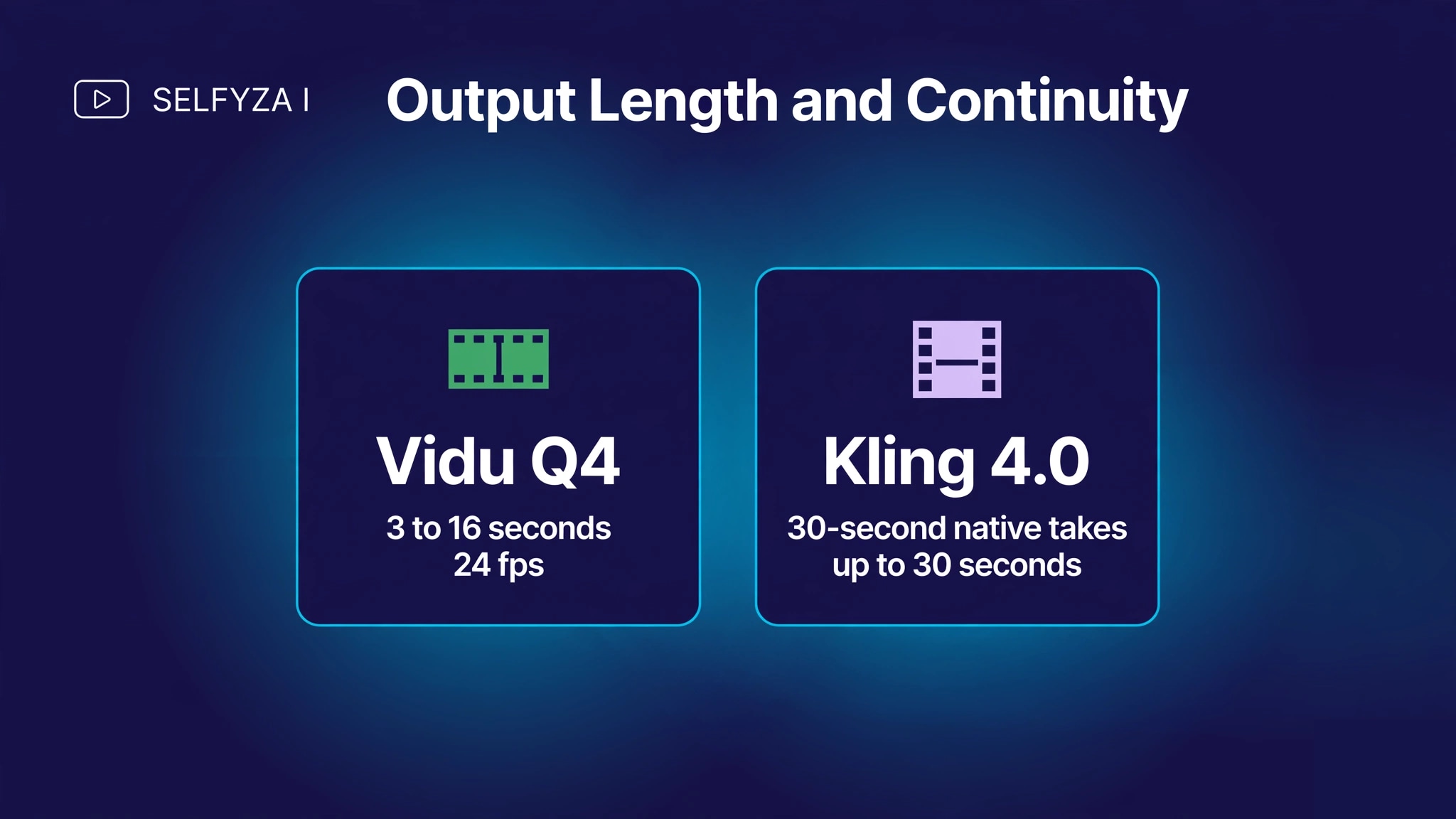
| Single-clip output | 3–16 seconds (any integer second), 24 fps, H.264 | Native 30s Generation — up to 30-second native single takes |
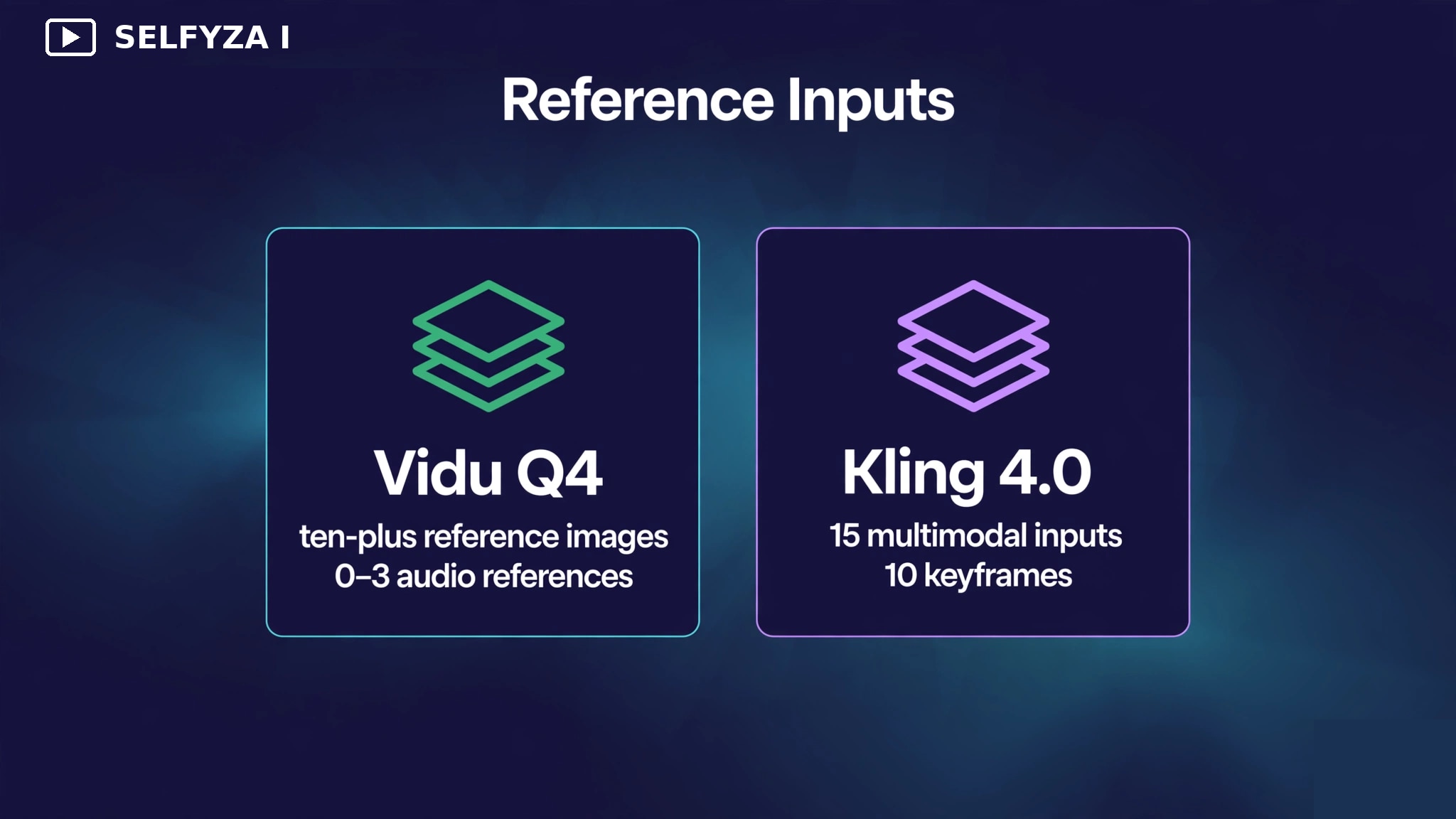
| Reference inputs | Ten-plus reference images (exact cap unconfirmed); 0–3 audio references | Omni Reference — up to 15 multimodal reference inputs; Multiple Keyframes — up to 10 per generation |
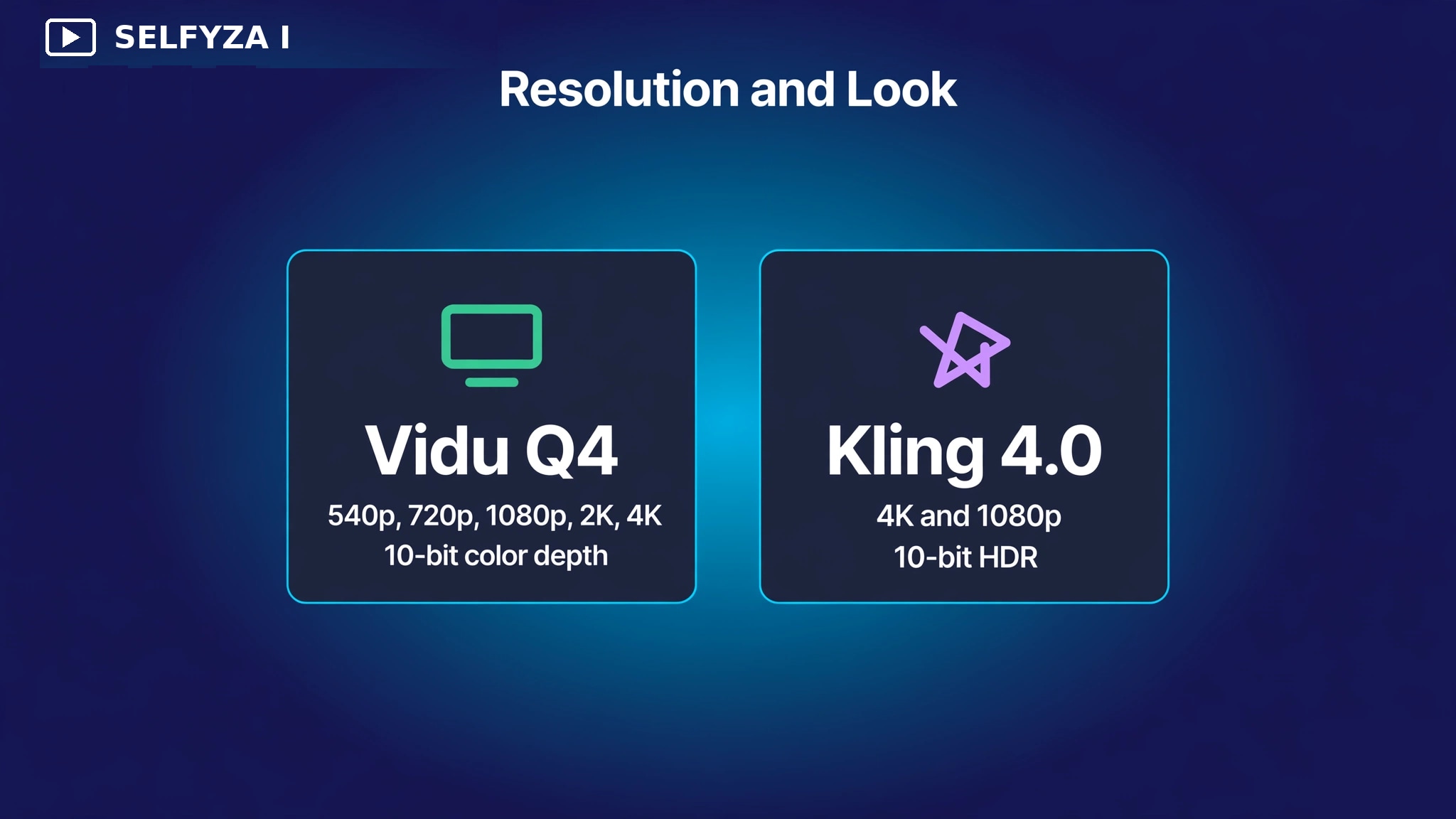
| Resolution | 540p, 720p, 1080p, 2K, 4K with 10-bit color depth | 4K/1080p Resolution with 10-bit HDR in beta; final specs confirmed at release |
| Aspect ratios | Image-to-video inherits the input ratio; reference-to-video offers 16:9, 1:1, 9:16, 4:3 and 3:4 | 21:9 Aspect Ratio announced alongside existing formats |
| Audio | Lip-sync accuracy and multi-dialogue support upgraded | Two-channel stereo Sound Effects, tighter Lip Sync, Multiple Languages, Accents, and Dialects |
| Availability outlook | First wave on the selfyz.ai picker once officially launched | Expected on selfyz.ai; SelfyzAI holds early beta access |
Output Length and Continuity
The two previews take different positions on the most practical question in video work: how much of a scene fits in one generation.
Vidu Q4's two modes — image-to-video and reference-to-video — both output clips of 3 to 16 seconds, at 24 frames per second in H.264, delivered as MP4, MOV or base64. That is dialogue-beat and action-beat scale: a line of dialogue, a turn, a chase, a product moment. Longer stories are built by sequencing clips, not by stretching one.
Kling 4.0's beta shows Native 30s Generation — native single takes of up to 30 seconds — roughly double the Vidu Q4 ceiling. Read in workflow terms, the number matters less than the step it removes: a 30-second native take cuts a joining pass out of scene work, and every join is a place where continuity can drift.
On selfyz.ai today, the web workspace outputs 2–15 second clips, and longer pieces are produced by generating several segments and joining them with extend video. Stills-led projects have a working route already: image to video turns a starting image into a clip, matching the shape of Vidu Q4's image-to-video mode. If your scene runs past a single clip, the workspace answer is to build it from short segments and join them — a real workflow today, no waiting required.
Reference Inputs
References are how a project pins down what the model must not invent: the face, the product, the logo, the voice. Here the two previews diverge in capacity.
Vidu Q4's reference-to-video mode accepts ten-plus reference images plus 0–3 audio references. We write "ten-plus" deliberately and state no exact cap — our beta testing confirmed generous multi-reference capacity, and the final ceiling is confirmed at release. Treat any site quoting a single exact number as unverified.
Kling 4.0's beta offers Omni Reference — up to 15 simultaneous reference inputs drawn from images, video, voice or subject references in combination, per the reference documentation — and Multiple Keyframes (up to 10 per generation), which pin the states a shot must pass through rather than leaving movement entirely to a text prompt. For scale, Kling's official documentation puts the previous generation's Elements system at up to four reference images per subject, so the move to 15 multimodal inputs is a large step up in capacity.
Reference-driven generation already exists in the workspace through reference to video, which conditions output on supplied images or video. If pinning a face, a product or a voice is the core of your brief, that route works with today's models — what these previews change is capacity and breadth, not the concept. And a higher ceiling is worth reading as a ceiling, since references that disagree with each other constrain a generation rather than improving it.
Resolution, Formats and Look
Vidu Q4 lists five output resolutions — 540p, 720p, 1080p, 2K and 4K — with 10-bit color depth, which keeps more color information in shadows and highlights for grading work. Its announced strengths read like a cinematographer's list: stable camera movement, upgraded semantic understanding, natural light and shadow, and large-scale narrative scenes. For delivery, higher-resolution drafts can be finished through video HD in the workspace.
Kling 4.0's beta shows 4K/1080p Resolution output with 10-bit HDR plus a new 21:9 Aspect Ratio. There is a conflict worth naming: a leaked settings file listed only 720p and 1080p, and several third-party sites read that as 4.0 dropping 4K. We do not repeat that reading, because it does not match what the beta shows — a settings file is a configuration, not a capability statement.
The honest position is that final specifications are confirmed at release, and the reference documentation carries a standing warning that they may change. Third-party trackers agree with the caution: a comparison published in September 2026 notes that Kling 4.0 has no official specification yet and treats its column as claims to test, not facts.
Who Should Pick Which: Vidu Q4 or Kling 4.0?
Match the model's announced focus to the bottleneck in your brief.
AI short drama and serialized narrative: Vidu Q4
Our Vidu Q4 beta runs covered this exact use: multi-dialogue scenes with improved line accuracy and lip-sync precision, stable character placement across multi-camera cuts, and finer micro-expressions. Kling 4.0 answers a different bottleneck — take length and continuity, with Native 30s Generation and Video Extension that extends a narrative forward and backward.
If dialogue and performance decide your episode, lean toward Vidu Q4; if scene length and joins are the pain, lean toward Kling 4.0. And if the episode needs to ship this month, MyStory Agent already assembles 15–90 second story pieces in 9:16, 16:9 or 1:1 from today's models.

Ads and marketing: Vidu Q4
Vidu Q4's tested strengths include product-appearance consistency, clean multi-language text rendering and brand-tone visuals — the unglamorous details that decide whether an ad is usable. Kling 4.0's preview adds localized Video Editing on existing footage and Text Generation for on-screen titles and product information. Commercial use of generated content is allowed for social, ads, marketing and brand content, subject to the platform's usage policy — check the current guidelines of any platform you publish to.
Music, social and character-led formats: Kling 4.0
Kling 4.0's audio side — two-channel stereo Sound Effects, tighter Lip Sync, Multiple Languages, Accents, and Dialects — lines up with music-led work, and MV Agent already builds music videos from an uploaded track of 15 to 160 seconds through lyric analysis, story outline, consistent character assets and per-shot generation.
In our beta testing, Vidu Q4's social formats covered dance, live-style, MV and transformation-effect formats with strong input-likeness consistency. For a song-driven piece, the audio handling points to Kling 4.0; for a character-consistency piece, the reference capacity of either model is the deciding factor.
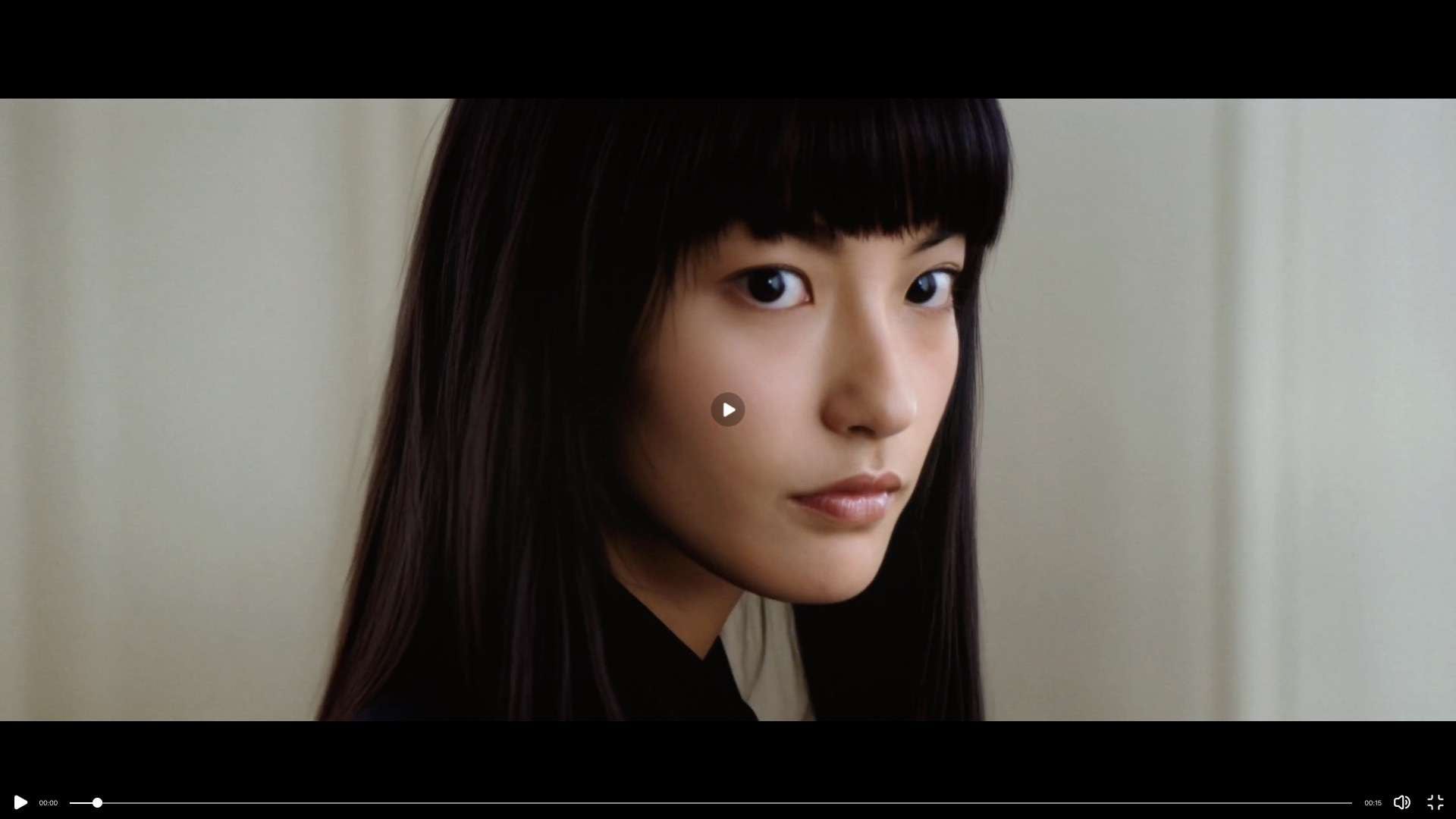
Which Fits Your Next Project? Choose by the constraint that hurts most. Dialogue, acting and camera craft — short dramas, character pieces, dialogue-heavy spots — lean toward Vidu Q4's announced focus. Longer continuous takes, Multiple Keyframes and Video Editing or Video Extension workflows — product films, ad matrices, serialized scenes — lean toward Kling 4.0's preview. If your brief genuinely needs both, that is the argument for not splitting the work across vendors: selfyz.ai's model picker is set up to host both models when they land — Vidu Q4 in the first wave once it officially launches — so one project can draw on Vidu Q4 for the performance shots and Kling 4.0 for the long takes.
The practical move today is to keep producing. Run the current picker — the Kling 3.0 family, Vidu Q3 Pro, Vidu Q2 Turbo — inside the AI video generator, and treat this page as a living preview: when either model goes live, the comparison above gets updated from beta findings to release results, and the picker gets the new entry as soon as possible.
Frequently asked questions
Can I try Vidu Q4 and Kling 4.0 on selfyz.ai right now?
Not yet — both are in a pre-release phase. SelfyzAI holds early beta access to Kling 4.0 and is also among Vidu Q4's first batch of beta testers. Kling 4.0 joins the picker as soon as possible after it goes live; Vidu Q4 will join in the first wave once it officially launches. The picker itself is the source of truth: new models appear there when they are actually available.
Which model should I pick for an AI short drama?
It depends on what limits your episode. Vidu Q4's announced focus is dialogue accuracy, lip-sync precision, stable multi-cut character placement and performance detail — the things that make a scene feel acted. Kling 4.0's preview answers a different need: Native 30s Generation and Video Extension, which reduce the joins where continuity drifts. Dialogue-led episodes lean Vidu Q4; length-led episodes lean Kling 4.0.
What input modes do the two previews support?
Our Vidu Q4 beta testing covered two modes: image-to-video, where the output inherits the input image's aspect ratio, and reference-to-video, which takes ten-plus reference images, 0–3 audio references, and offers 16:9, 1:1, 9:16, 4:3 and 3:4 ratios. Kling 4.0's preview centers on keyframe and reference control — Multiple Keyframes (up to 10) and Omni Reference (up to 15 multimodal reference inputs) per generation — with text-driven generation as the base mode.
How do the two models handle audio?
In our beta testing, Vidu Q4 accepted 0–3 audio references alongside images, with upgraded lip-sync accuracy aimed at multi-dialogue scenes. Kling 4.0's beta shows two-channel stereo Sound Effects, tighter Lip Sync matching, and improved handling of Multiple Languages, Accents, and Dialects. Neither preview publishes an audio bitrate or sample rate, so treat the audio rows as direction, not specifications.
Will this comparison be updated when the models go live?
Yes. Pre-release specifications can change, and this article will switch from beta findings to release results once the models are actually available — only the wording changes, the structure stays. The model picker on selfyz.ai is where a new entry appears first.
Conclusion
Two previews, two different bets. Vidu Q4 bets that performance, dialogue and camera craft decide whether a project lands; Kling 4.0 bets that longer takes and tighter control over each shot do. Your next project already tells you which bet matters more — match the model's announced focus to the bottleneck in your brief, and keep the other model in mind for the shots where its strength applies.
If your brief needs both strengths, there is no reason to split the work across vendors: selfyz.ai is set up to host the two models side by side, so a single project can use Vidu Q4 for the performance shots and Kling 4.0 for the long takes once both have gone live — Vidu Q4 joining in the first wave. Until then, keep the current picker working — and re-check this page after release, when beta specs become run specs.